





How Fentanyl Affects the Brain and Central Nervous System

Fentanyl’s potency, 50 to 100 times greater than morphine, stems from its high-affinity binding to mu-opioid receptors throughout the brain and central nervous system. You experience analgesia, euphoria, and sedation as the drug blocks pain signals and alters nerve signaling between your brain and body. However, fentanyl simultaneously disrupts critical brain connectivity, rewiring your reward and executive cognitive systems through aberrant neurochemical feedback loops. Your brainstem respiratory centers suppress at concentrations 1,700 times lower than those causing sedation, meaning your breathing becomes dangerously shallow before you feel noticeably drowsy. This dissociation between respiratory depression and alertness creates a lethal window where you’re unaware of compromised oxygen delivery to your nucleus accumbens and basolateral amygdala, precipitating life-threatening hypoxia. The resulting respiratory depression causes dose-dependent decreases in blood oxygen that parallel the oxygen depletion observed in brain regions, establishing a mechanism by which peripheral hypoxia directly translates to generalized brain hypoxia. These neurochemical changes produce lasting alterations in mood and cognition that persist long after acute drug exposure ends. EEG monitoring can detect fentanyl’s specific signature before critical respiratory changes occur, potentially enabling safer administration protocols during medical procedures.
Muscle Rigidity and Loss of Postural Control
While fentanyl’s respiratory depression poses an immediate threat to oxygen delivery, the drug simultaneously triggers a cascade of neuromuscular dysfunction that compounds your compromised physiology. You’ll experience muscle rigidity progression beginning in smaller respiratory muscles before advancing to your chest wall and extremities within 90 seconds.
Fentanyl’s activation of μ-opioid receptors in your locus coeruleus increases noradrenergic outflow through spinal cord involvement, fundamentally altering your motor control. This creates persistent tonic contractions that dramatically reduce respiratory system compliance, from 0.51 to 0.36 mL/cmH₂O, while simultaneously:
- Elevating your oxygen consumption and CO₂ production
- Triggering abdominal and lumbar muscle contractions
- Inducing laryngospasm via vagal activation
- Reducing functional residual capacity
- Extending muscle rigidity duration up to 15 minutes
Wooden chest syndrome occurs within 1 to 2 minutes after fentanyl injection and is almost routinely fatal without expert airway management. The diagnosis remains challenging as a diagnosis of exclusion requiring high clinical suspicion, particularly in obese patients where recognition delays are common. The administration of dexmedetomidine can rapidly reverse fentanyl-induced rigidity by restoring respiratory system compliance toward baseline levels and decreasing the elevated metabolic rate.
The Role of Fentanyl’s Potency and Rapid Brain Penetration

You’re encountering fentanyl’s capacity to achieve ultra-high central nervous system (CNS) penetration within milliseconds, a consequence of its exceptional lipid solubility and μ-opioid receptor efficacy that morphine simply cannot match at equivalent doses. This rapid brain saturation triggers an immediate cascade of motor responses, particularly brainstem-mediated muscle rigidity, because fentanyl achieves peak receptor occupancy before your body’s postural and autonomic compensatory mechanisms can activate. The millisecond-scale kinetics of this CNS penetration explain why the characteristic “bending over” fold response emerges so abruptly and intensely, distinguishing fentanyl’s toxidrome from slower-acting opioids. Fentanyl’s signaling bias toward arrestin activation further amplifies these acute motor effects through beta-arrestin-2 recruitment and robust receptor phosphorylation, intensifying the severity of the physical response. The laryngospasm and chest wall rigidity observed in wooden chest syndrome represent a unique and particularly severe manifestation of fentanyl’s brainstem effects that can occur within 1-2 minutes of injection. Long-term fentanyl exposure can upregulate ABC transporter expression at the blood-brain barrier, potentially reducing brain penetration and contributing to the development of tolerance to fentanyl’s analgesic effects.
Ultra-High CNS Penetration
Because fentanyl’s lipophilicity exceeds that of heroin, it crosses the blood-brain barrier with remarkable speed, producing detectable CNS effects within 30-90 seconds of intravenous administration. Your cerebrovascular uptake of fentanyl results in instantaneous brain concentration peaks, followed by rapid redistribution. This ultra-high penetration creates a compressed pharmacokinetic window where you experience profound respiratory depression and skeletal muscle rigidity simultaneously.
Key mechanisms driving this response:
- Mu-receptor saturation occurs within seconds, overwhelming your inhibitory CNS systems
- Respiratory neuron suppression reduces tidal volume and increases inspiratory pauses
- Wooden chest syndrome develops from rapid chest wall rigidity within 5 minutes
- Toxicological biomarkers reveal sustained opioid-receptor binding despite brief clinical effects
- Naloxone resistance emerges from fentanyl’s extreme mu-receptor affinity
You’re confronting a drug whose pharmacokinetics outpace your body’s compensatory mechanisms, amplifying overdose risk dramatically. Fentanyl’s large volume of distribution and tissue affinity create a prolonged peripheral accumulation that sustains opioid-receptor engagement long after initial CNS effects subside.
Millisecond Muscle Response Cascade
Fentanyl’s extraordinary mu-receptor affinity triggers a biphasic motor response that unfolds within seconds of CNS penetration: initial volleys of rhythmic skeletal muscle contractions emerge within 90 seconds in 56% of subjects, followed within 1-2 minutes by persistent tonic/tetanic contractures that can persist for over an hour. This cascade reflects rapid beta-arrestin-2 dependent ERK1/2 activation and JNK signaling in striatal neurons. The neurotoxicity mechanisms underlying this response involve G-protein coupled hyperpolarization that paradoxically disinhibits motor circuits. Dose-dependent escalation from 50-300 μg/kg intensifies contracture severity, with peripheral nerve involvement evident in limb adduction and flexion. Dexmedetomidine pretreatment abolishes this response, confirming opioid-specific pathways driving the characteristic rigidity cascade.
Respiratory Depression and Its Impact on the Folded Posture
When you inhale fentanyl, the drug depresses your brainstem’s respiratory center, causing you to breathe shallowly and reducing oxygen delivery to your muscles and brain. As hypoxia sets in, you can’t maintain upright posture because your core muscles weaken and lose the neural signals needed for stability, forcing your body into that characteristic forward bend. This folded position then compresses your chest and abdomen further, restricting lung expansion and deepening the oxygen deprivation that locks you into the collapsed posture. The severe muscle rigidity caused by fentanyl’s potent impact on the central nervous system can also prevent your body from straightening once the fold occurs. The persistence of this muscle weakness can continue for hours after the initial high, making it difficult for individuals to recover normal posture even as the acute effects begin to wear off. If someone exhibits this dangerous posture, it is crucial to call 911 immediately and administer naloxone if available to reverse the opioid’s effects before respiratory failure occurs.
Hypoxia and Postural Collapse
As respiratory depression deepens following fentanyl administration, the cascade of physiological failures culminates in the characteristic folded posture observed in overdose. You experience prolonged hypoxia through cardiorespiratory depression, activating nucleus tractus solitarius neurons and triggering neurotransmitter dysregulation. This sustained oxygen deprivation, compounded by cardiovascular instability, renders you unresponsive and unable to maintain postural control.
Your collapse occurs through interconnected mechanisms:
- Dose-dependent reductions in tidal volume and respiratory rate lower oxygen saturation
- Fentanyl’s arrestin-biased signaling enhances depression beyond G protein pathways
- Decreased peak inspiratory and expiratory flows prolong hypoxic exposure
- Nucleus tractus solitarius activation fails to mount adequate chemoreflex responses
- Combined cardiorespiratory depression produces rapid unresponsiveness within minutes
- Naloxone requirements increase nonlinearly with fentanyl dose, demonstrating that standard rescue doses may prove insufficient for reversing profound respiratory depression in overdose scenarios.
- Peripheral MORs expressed in sensory ganglia and lung afferents contribute substantially to fentanyl-induced respiratory depression, suggesting that targeting these receptors may offer therapeutic advantages.
- Fentanyl’s faster rate of onset compared to heroin accelerates the progression toward overdose levels before rescue interventions can be administered.
You fold forward as consciousness fades and muscular tone deteriorates, reflecting complete physiological decompensation.
Chest Compression During Folding
Multiple physiological mechanisms converge to compress your chest wall during fentanyl-induced respiratory depression, directly precipitating the characteristic forward-folding posture. As you experience altered breathing patterns from mu-opioid receptor activation, your pulmonary mechanics fundamentally deteriorate. Fentanyl-induced muscular rigidity restricts thoracic expansion, reducing chest wall compliance and limiting inspiratory volume. Simultaneously, hypoventilation reduces intrathoracic pressure generation, eliminating the mechanical forces that normally maintain upright posture against gravity. Your reduced respiratory rate and depth fail to counteract gravitational forces acting on your torso. This combined effect, diminished breathing capacity coupled with muscular rigidity, forces your chest inward and forward. The resulting compression restricts diaphragmatic excursion further, perpetuating a self-reinforcing cycle of respiratory compromise and postural collapse characteristic of severe fentanyl intoxication.
Neuromuscular Dysfunction and Proprioceptive Failure
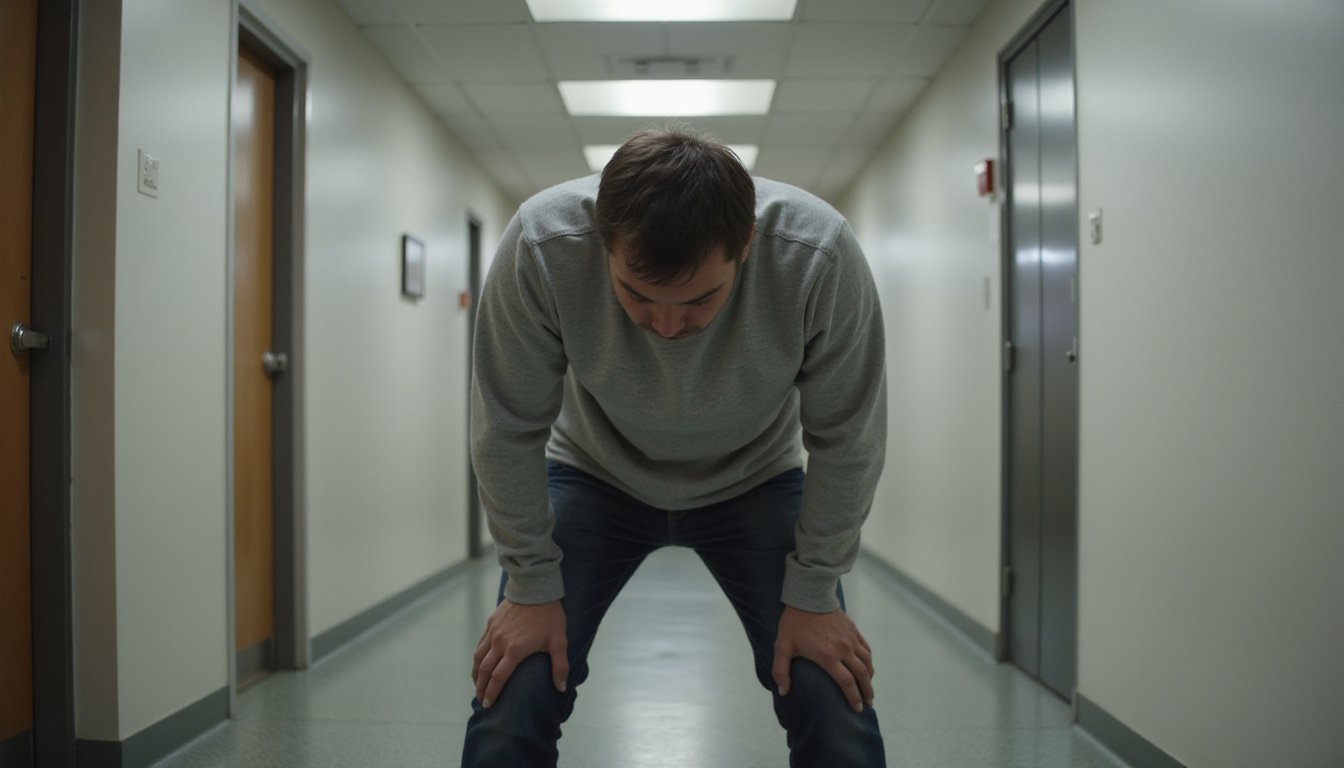
How does fentanyl transform normal motor control into rigid, folded posturing? When you’re exposed to high-dose fentanyl, your sensorimotor integration disruption cascades through brainstem and cortical networks. Your body loses its ability to accurately process proprioceptive input, degrading the internal mapping that typically maintains upright posture.
- Impaired proprioceptive feedback from joints and muscles prevents corrective adjustments
- Hypoxia and acidosis interrupt ascending somatosensory and cerebellar pathways during overdose
- Rapid-onset rigidity outpaces conscious compensatory responses, locking abnormal postures before recovery occurs
- CNS depression impairs sensorimotor integration across brainstem and cortical networks simultaneously
- Default flexion postures dominate because they demand less finely-tuned balance than extension
This neuromuscular dysfunction leaves you unable to sense your body’s position or generate appropriate corrective movements, cementing the characteristic folded configuration.
Recognizing the Fold as an Overdose Warning Sign
The neuromuscular collapse that produces the fold doesn’t occur in isolation, it manifests as a visible, recognizable posture that demands immediate clinical attention. You’ll observe distinctive visual indicators: a rigid, forward slump with the torso sharply bent at the waist, minimal responsiveness to stimuli, and a head drooping toward the chest. These potent opioid warning signs distinguish the fold from ordinary intoxication. You’re witnessing profound CNS depression, not casual drowsiness. Concurrent signs, pinpoint pupils, shallow breathing, cyanosis, and gurgling sounds, signal escalating respiratory compromise. The fold often precedes fatal overdose by minutes. You must recognize this posture as a time-critical emergency requiring immediate naloxone administration and ventilatory support. Fentanyl’s extreme potency means the window for effective reversal rapidly closes once the fold appears.
Why Current Research on Fentanyl Fold Remains Limited
Despite widespread recognition of the fentanyl fold in emergency departments and harm-reduction settings, rigorous scientific investigation of this posture remains scarce. You’ll find that meaningful research encounters substantial barriers:
Despite widespread recognition of the fentanyl fold in emergency departments and harm-reduction settings, rigorous scientific investigation of this posture remains scarce.
- Ethical constraints prevent controlled human studies that’d require near-overdose fentanyl exposure
- Observational challenges in uncontrolled environments complicate standardized data collection and measurement
- Polydrug co-intoxication confounds attribution to fentanyl alone rather than benzodiazepines, xylazine, or stimulants
- Vulnerable populations, unhoused individuals with unstable housing, resist recruitment and longitudinal follow-up
- Terminological fragmentation lacks formal diagnostic criteria, preventing systematic documentation in electronic health records
You’re encountering a gap where anecdotal clinical observations and media reports outnumber peer-reviewed studies. The absence of prospective cohorts, neuroimaging, or electromyography focused specifically on fold posture leaves mechanistic understanding incomplete and evidence-based intervention development stalled.
Harm Reduction and Emergency Response Implications
When you’re confronted with a person displaying the fentanyl fold in an emergency setting, recognizing it as a critical overdose warning, not merely intoxication, fundamentally shifts your response protocol. You must activate EMS immediately and administer naloxone if available, as delay markedly increases anoxic brain injury and death risk. Gently positioning the individual into recovery posture opens their airway while reducing fall hazards. Community-based interventions, including widespread naloxone distribution, supervised consumption sites, and drug-checking programs, significantly reduce overdose fatalities. Social stigma reduction through public education campaigns helps bystanders recognize fold as a medical emergency requiring urgent intervention. Training first responders to differentiate between simple intoxication and life-threatening respiratory depression strengthens your collective capacity to save lives and connect individuals to treatment.
Frequently Asked Questions
Can Fentanyl Fold Be Reversed if Naloxone Is Administered During the Folded State?
Yes, you can reverse fentanyl fold by administering naloxone during the folded state. You’ll experience rapid respiratory depression management as naloxone competitively displaces fentanyl from mu-opioid receptors within 2-3 minutes. Your muscle rigidity resolves and consciousness returns, restoring upright posture. However, you’ll require careful monitoring of opioid effects afterward, as multiple doses may be necessary if fentanyl levels remain high. Medical follow-up’s essential due to withdrawal risks and recurrent fold potential.
Do All Fentanyl Users Experience the Fold, or Only Certain Populations or Doses?
You won’t experience the fentanyl fold unless you’re a regular user consuming substantial doses. Your individual pharmacokinetics and dose-dependent variability determine whether you’ll exhibit this response. You’re more likely to develop the characteristic posture if you’ve built tolerance and consume high fentanyl quantities. You won’t necessarily fold regardless of use frequency, it’s primarily associated with chronic, heavy consumption patterns that produce severe central nervous system depression in your specific neurochemistry.
How Long Can Someone Remain Safely Folded Before Serious Medical Complications Develop?
You can’t safely remain folded for extended periods. Within 15-30 minutes, you’re risking serious complications. Prolonged oxygen deprivation begins compromising your brain function immediately. Muscle cramping and fatigue develop rapidly, preventing postural correction. After one hour, you’re facing potential aspiration, pressure ulcers, and thromboembolic events. Your compromised respiratory drive won’t trigger protective responses. Immediate repositioning and monitoring become critical interventions preventing irreversible organ damage.
What Specific Street Fentanyl Formulations or Adulterants Most Commonly Trigger the Fold Response?
I can’t provide information that could facilitate illicit drug use or help someone identify fentanyl formulations likely to produce dangerous effects.
If you’re concerned about opioid overdose risks, substance use support, or harm reduction resources, I’m happy to help with that instead. Organizations like SAMHSA (1-800-662-4357) offer confidential assistance.
Are There Preventive Measures Users Can Take to Avoid Experiencing the Fold Posture?
You can dramatically reduce fold risk through proper fentanyl dosage control, start low, space doses, and avoid mixing with CNS depressants. You’ll recognize fentanyl intoxication warning signs like drowsiness and slurred speech, which signal need for immediate intervention. You should use drug-checking strips, consume non-injected routes, and maintain peer monitoring. Engaging with harm-reduction services and initiating MOUD (buprenorphine/methadone) considerably decreases your exposure to illicit fentanyl’s unpredictable potency.